
She Wrote Her Own Essay. GPTZero Said She Cheated. Now She’s Suing.
A discovery that was supposed to catch AI cheaters is flagging real students instead — and the backlash is just beginning.
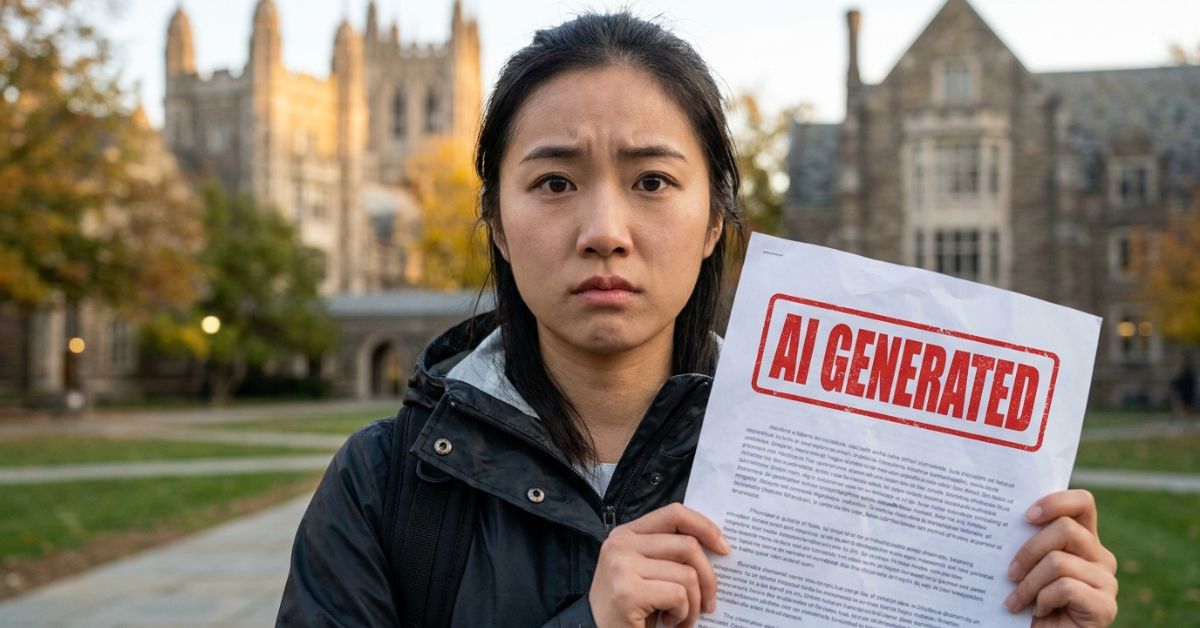
The email arrived at 3:14 PM on a Tuesday. Sarah Chen, a graduate student at Yale’s School of Management, had been suspended. Her offense? GPTZero — the AI detection tool her university trusted to police academic integrity — had flagged her exam as AI-generated.
There was just one problem.
Sarah wrote every word herself. She’s a non-native English speaker who learned to write clean, structured academic prose. To GPTZero, that looked exactly like a machine.
She sued Yale in February 2025. She’s not the only one.
The Tool That Took Over Classrooms
GPTZero launched in January 2023, built by Princeton undergraduate Edward Tian over winter break. Within a week, 30,000 people crashed the servers. Within three years, it grew to 17 million users — 1 million of them educators — and scanned over a billion documents.
Schools adopted it at breakneck speed. Universities from the University of Louisiana system to Purdue integrated GPTZero directly into their grading platforms, letting teachers see AI probability scores alongside student submissions without leaving Canvas or Google Classroom. It felt like the solution every educator had been waiting for.
But the tool that was supposed to restore academic integrity may have been creating a crisis of its own.
The Accuracy Gap
GPTZero’s marketing claims a 0.5% false positive rate — one error in every 200 documents. Nearly flawless. But when independent researchers from the University of Maryland put GPTZero through its paces on real student submissions across 32 university courses, they found something very different.
The false positive rate: 18%.
Nearly one in five human-written essays flagged as AI-generated.
GPTZero’s own 2026 benchmarks tell a different story from their public-facing claims. On the Chicago Booth School of Business independent benchmark, GPTZero scored 99.5% accuracy — but those tests used clean, unmodified AI output. Real student writing is never clean.
“Detection is a probability reading, not a verdict,” GPTZero’s own team has publicly stated. But by the time a student is facing suspension, that nuance has often disappeared.
The Arms Race Nobody Wins
In January 2026, GPTZero made headlines for an entirely different reason. The company analyzed 4,841 papers accepted by NeurIPS — the world’s most prestigious AI conference — and found at least 100 papers contained hallucinated citations. The irony wasn’t lost on anyone: AI detection tools finding AI-generated garbage in an AI conference.
The detection arms race is accelerating. When OpenAI released GPT-5, GPTZero claims 100% detection. But students have already adapted — using AI humanizers, paraphrasing tools, and manual editing to evade detection. Originality.ai catches 100% of QuillBot-paraphrased text. GPTZero returns an inconclusive coin-flip result.
The tools keep updating. The evasions keep evolving.
What It Means For You
If you’re a student, your university may already be using GPTZero without your knowledge. If you’re a teacher, the tool in your grading dashboard may be more confident than it should be. If you’re a non-native English speaker, you’re statistically at higher risk of being falsely accused.
GPTZero’s team has published guidance warning that a single detection score should never be used as sole evidence in academic misconduct cases. But in practice, that’s exactly what’s happening.
Where Things Stand Now
The Yale lawsuit is ongoing. Dozens more cases are working their way through appeals at universities across the country. Meanwhile, GPTZero continues to grow — raising $10 million in Series A funding, hiring across six continents, and expanding into hiring and publishing markets.
Edward Tian, the founder who built GPTZero in his Princeton dorm room, now leads a company shaping how institutions decide what’s human and what isn’t. The tool scans more than a billion documents. It’s embedded in the infrastructure of education.
But the question that student in New Haven asked — the one who wrote her own exam and got suspended anyway — has never been adequately answered:
What happens when the detector is wrong?