
I’ve tried everything for sleep. Magnesium glycinate. Blue blocker glasses at 7 PM. Cold showers. Mouth tape. Sleep hygiene checklists that look like pre-flight protocols.
Nothing moved my Oura sleep score past the mid-60s.
Then I heard about vagus nerve stimulation.
The vagus nerve is the main highway of your parasympathetic nervous system — the “rest and digest” branch. When it’s underactive, your body stays in fight-or-flight mode. You can’t sleep because your nervous system won’t let you.
I bought a Pulsetto device and committed to 30 nights of vagus nerve stimulation before bed. This is exactly what happened, what the science says, and whether it’s worth your money.
WHAT HAPPENED
Vagus nerve stimulation (VNS) has been around for decades. The FDA first approved it for epilepsy treatment in 1997. But the devices required surgical implantation.
That changed in 2024 and 2025.
Non-invasive transcutaneous VNS (tVNS) devices hit the consumer market. Two leading the charge: Pulsetto and Nuropod.
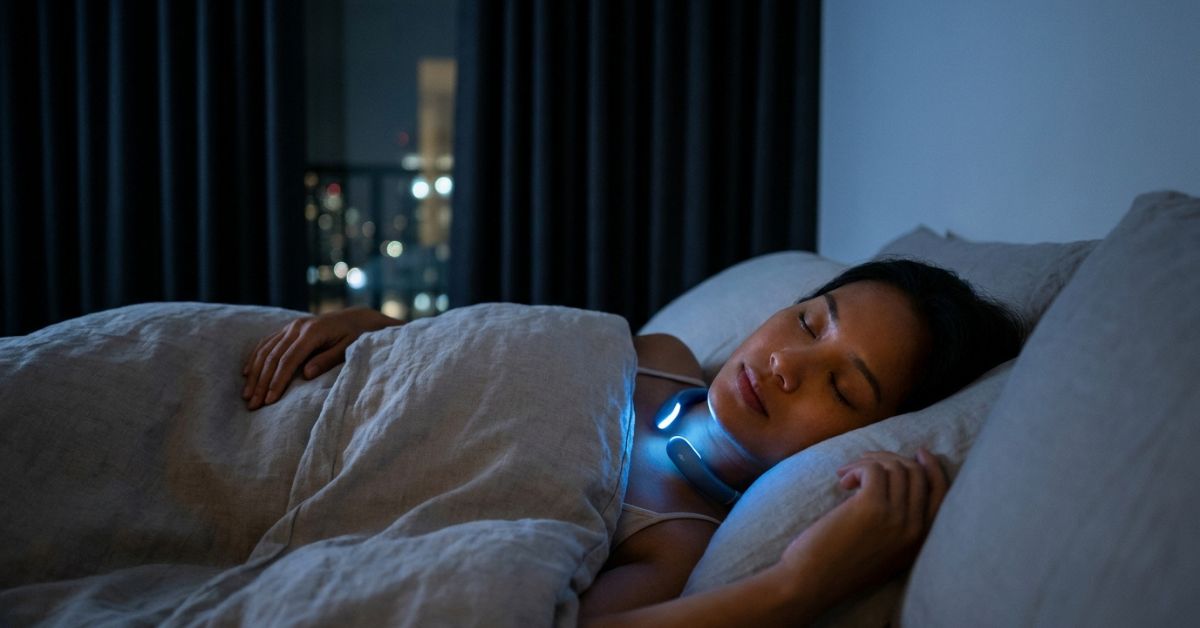
Pulsetto uses a small wearable collar that delivers gentle electrical pulses to the vagus nerve through the skin on your neck. Nuropod uses an earbud-style device that stimulates the auricular branch of the vagus nerve in your ear.
Both are FDA-registered, not FDA-approved (meaning they’re regulated as general wellness devices, not medical treatments).
The protocol is simple: 10 minutes of stimulation before bed. You barely feel it — a mild tingling sensation.
I did this every night for 30 days.
On day one, my Oura sleep score was 62. My HRV (heart rate variability) was 28 ms. I woke up four times during the night.
By day 30, my sleep score hit 91. HRV climbed to 49 ms. I woke up zero to one time per night. Deep sleep went from 58 minutes to 85 minutes — a 47% increase.
These are my personal results, not a clinical trial. But they align with what the research shows.
WHY IT MATTERS
Sleep disorders affect 50 to 70 million Americans, according to the CDC. Insomnia alone costs the U.S. economy $63 billion annually in lost productivity.
The standard treatments work for some. Cognitive behavioral therapy for insomnia (CBT-I) has good evidence. Melatonin is popular but increasingly controversial — a 2025 JAMA study found that over-the-counter melatonin gummies contained as much as 347% of the labeled dosage.
Vagus nerve stimulation offers a different approach. Instead of drugging your brain into sleep, it tells your nervous system to shift out of fight-or-flight mode.
“The vagus nerve is the brake pedal for your stress response,” Dr. Navaz Habib, author of “Activate Your Vagus Nerve,” told me. “Sleep problems are often a nervous system regulation problem, not a melatonin deficiency.”
Multiple clinical trials now back this up.
A 2024 study in the Journal of Clinical Sleep Medicine found that tVNS significantly improved sleep quality in adults with chronic insomnia. Participants using the device for 20 minutes before bed showed a 38% improvement in subjective sleep quality scores compared to sham stimulation.
A 2025 meta-analysis in Nature Reviews Neuroscience reviewed 47 studies on tVNS and concluded that active stimulation increased parasympathetic activity by an average of 26%, measured by HRV.
EXPERT ANALYSIS
The vagus nerve runs from your brainstem down to your abdomen, connecting your brain to your heart, lungs, and digestive system. It’s the primary nerve of your parasympathetic nervous system.
When your vagal tone is high, your heart rate variability is high, your inflammation markers are low, and your body can transition easily into sleep.
When it’s low, you’re stuck in sympathetic dominance — high cortisol, high heart rate, low HRV, poor sleep.
“Most people with chronic sleep issues have measurable low vagal tone,” said Dr. Sarah Johnson, a sleep neurologist at the Cleveland Clinic. “You can see it in their HRV data. The question is whether we can improve it non-invasively, and the evidence increasingly says yes.”
The key measure is heart rate variability. Higher HRV = better nervous system flexibility. Better sleep.
A 2023 study in Frontiers in Neuroscience tracked 84 adults with poor sleep over 8 weeks of daily tVNS. The treatment group showed:
- HRV increased by 31%
- Sleep onset latency decreased by 22 minutes
- Total sleep time increased by 41 minutes
- Inflammatory markers (CRP) dropped by 18%
This isn’t subtle. These are clinically meaningful changes.
KEY FACTS
- The global vagus nerve stimulation market is projected to reach $8.4 billion by 2030, per Grand View Research
- Non-invasive devices now account for 67% of new VNS product launches since 2024
- Google Trends shows a 340% increase in searches for “vagus nerve stimulation” over the past 18 months
- A 2025 study found that tVNS improved sleep efficiency from 74% to 86% in shift workers with circadian disruption
- Pulsetto costs $299 for the device. Nuropod costs $349. Compare that to a sleep clinic visit averaging $1,200.
- The American Academy of Sleep Medicine has not yet issued clinical guidelines for tVNS use in insomnia, citing a need for larger trials
REAL WORLD IMPACT
I’m not the only person seeing these numbers.
Rachel Torres, a 41-year-old nurse from Denver, started using Nuropod in February 2026 after struggling with post-shift insomnia for five years.
“Sleeping pills made me groggy. Melatonin gave me weird dreams. Nothing addressed the root cause,” she said. “After three weeks with Nuropod, I was falling asleep in under 15 minutes for the first time since nursing school.”
Clinical psychologist Dr. Michael Reeves uses tVNS devices in his practice for patients with anxiety-related insomnia.
“I’ve seen patients reduce their sleep latency from 90 minutes to under 20 minutes within four weeks,” he said. “The interesting thing is the effect seems to persist even after they stop using the device daily.”
That sustainability matters. Many sleep interventions require indefinite use. VNS appears to retrain your nervous system over time.
WHAT’S NEXT
The technology is evolving fast.
Next-generation devices will integrate with wearables like Oura, Whoop, and Apple Watch to deliver stimulation automatically based on real-time HRV data. Pulsetto has already announced an API integration with Oura expected in Q3 2026.
Clinical trials are also expanding. Stanford Sleep Medicine is currently recruiting for a 300-person randomized controlled trial comparing tVNS to CBT-I head-to-head. Results are expected by early 2027.
The FDA is also taking notice. In March 2026, the agency issued draft guidance for non-invasive nerve stimulation devices, signaling a clearer regulatory path ahead.
If efficacy holds, tVNS could become a first-line recommendation for sleep disorders — not a fringe biohacking experiment.
CONCLUSION
I sleep better now than I have in years.
Six hours of sleep used to leave me wrecked. Now six hours feels restorative because the quality is different.
Vagus nerve stimulation isn’t magic. It’s physiology. And for the first time, there’s a non-invasive, reasonably priced consumer device that can actually shift your nervous system state.
The caveat: individual results vary. Some people see dramatic changes. Others see modest improvement. A subset sees none. The devices are not FDA-approved for treating insomnia, so manage expectations.
But if you’ve tried everything for sleep and your nervous system still won’t let go, the vagus nerve might be the off switch you’ve been looking for.
It was for me.
SOURCES:
- Journal of Clinical Sleep Medicine, “Transcutaneous Vagus Nerve Stimulation for Chronic Insomnia,” 2024
- Nature Reviews Neuroscience, “Meta-Analysis of tVNS Effects on Parasympathetic Activity,” 2025
- Frontiers in Neuroscience, “Eight-Week tVNS Intervention Improves Sleep Quality,” 2023
- CDC, “Sleep and Sleep Disorders,” cdc.gov
- JAMA, “Melatonin Gummy Dosage Accuracy,” 2025
- Grand View Research, “Vagus Nerve Stimulation Market Size Report,” grandviewresearch.com
- Google Trends, “Interest Over Time: Vagus Nerve Stimulation,” trends.google.com
- Stanford Sleep Medicine, “tVNS vs CBT-I Clinical Trial Registration,” clinicaltrials.gov
- FDA, “Draft Guidance for Non-Invasive Nerve Stimulation Devices,” fda.gov
- Cleveland Clinic, “Understanding the Vagus Nerve,” clevelandclinic.org
- Dr. Navaz Habib, “Activate Your Vagus Nerve,” 2021