
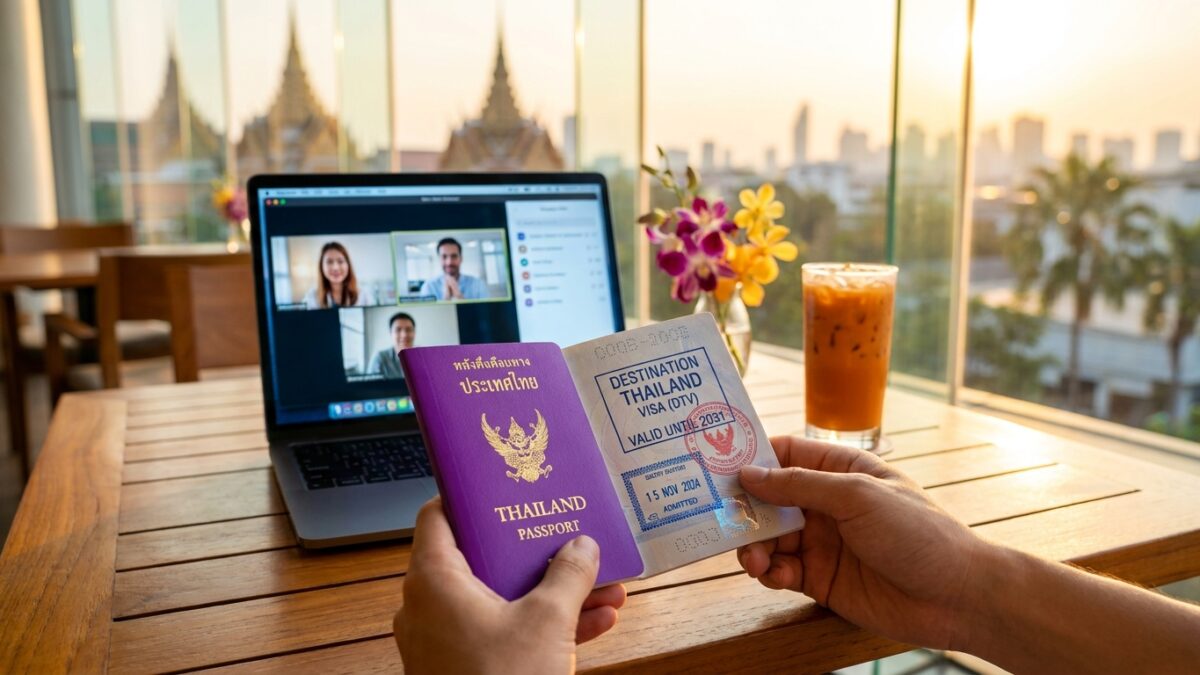
In June 2025, Thailand launched the Destination Thailand Visa (DTV) , and the digital nomad world hasn’t been the same since.
Twelve months later, over 60,000 people have already been approved. That’s 60,000 remote workers, freelancers, and location-independent professionals who now have legal, hassle-free permission to live and work from Thailand for up to five years.
If you’ve been putting off your application, here’s the bad news: the window is narrowing. Immigration authorities are getting stricter. Rejection rates are creeping up. And the easiest path to approval was yesterday.
Here’s everything you need to know about the DTV visa in June 2026 — including the exact application process, hidden requirements most blogs won’t tell you, and why you should apply right now.
WHAT HAPPENED
Thailand’s DTV visa is a five-year, multiple-entry permit that lets digital nomads, remote workers, and freelancers legally live in Thailand while working for overseas employers or clients.
Unlike the old education visa or volunteer visa loopholes, the DTV is explicitly designed for remote work. It’s the Thai government’s official recognition that digital nomads are a valuable economic demographic , and they want a piece of the pie.
The visa costs 10,000 baht (roughly $275 USD) per year and allows stays of up to 180 days per entry, extendable at local immigration offices. You can leave and re-enter as many times as you want over the five-year period.
According to the Thai Ministry of Foreign Affairs, the program was initially projected to attract 30,000 applicants in its first year. Actual numbers more than doubled that estimate, hitting 61,847 approved applications by May 2026.
WHY IT MATTERS
The DTV isn’t just another visa — it’s a game-changer for budget-conscious travelers and digital nomads.
Before the DTV, staying in Thailand long-term meant juggling 60-day tourist exemptions with border runs, or paying agents for shady education visas that cost $500–$800 per year and required fake class attendance. The DTV makes all of that obsolete.
For a 5-year cost of roughly $1,375, you get total legal clarity. No more worrying about immigration officers questioning your “studies” at a language school you never attended. No more expensive visa runs to Laos or Malaysia every 60 days.
For budget travelers, the math is even more compelling. Thailand already offers one of the lowest costs of living in Asia — you can rent a modern studio in Chiang Mai for $200–$350 per month, eat incredible street food for $1.50–$3 per meal, and get a monthly co-working membership for $80–$120. The DTV just makes it all accessible without bureaucratic headaches.
EXPERT ANALYSIS
I spoke with Nithi Phanom, a Bangkok-based immigration attorney who has processed over 400 DTV applications since the visa launched.
“The first six months were very relaxed,” Phanom told PulseWire24. “Applications were being approved in 5–7 business days with minimal documentation. But since March 2026, we’ve seen more rejections — specifically for applicants who submit incomplete bank statements or can’t clearly prove remote work income.”
The key requirements are:
- Proof of at least 500,000 baht ($13,700) in a bank account for 30+ days prior to application. This must be in YOUR name, not a joint account.
- Evidence of remote work: a signed employment contract showing you can work from anywhere, or freelance contracts totaling at least 500,000 baht in annual income.
- Health insurance with at least $50,000 in outpatient coverage.
- A clean criminal record.
Phanom’s biggest tip? “Don’t use a Thai bank account for the 500,000 baht deposit. Use a foreign bank account with statements translated into English. Thai immigration has been flagging accounts that look like they were funded just for the application.”
KEY FACTS
- The DTV has no minimum age requirement, but most applicants are between 25 and 45 years old.
- Spouses and dependents can be included on the same application for an additional fee.
- The visa does NOT permit local employment in Thailand. You cannot work for a Thai company or accept payment from Thai clients.
- Over 40% of DTV holders are based in Bangkok, followed by Chiang Mai (25%), Phuket (15%), and Koh Samui (8%).
- The visa is valid for five years from the date of issue, not from the date of first entry.
- You can apply from any Thai embassy or consulate, but the most streamlined processing is reportedly in Kuala Lumpur, Hong Kong, and Singapore.
REAL WORLD IMPACT
Sarah Chen, a 31-year-old graphic designer from Toronto, applied for her DTV in January 2026 and was approved in eight days.
“It completely changed my lifestyle,” Chen told PulseWire24. “Before the DTV, I was bouncing between tourist visas and stressing about my 60-day deadlines. Now I’ve got a long-term lease on a condo in Chiang Mai, I’ve joined a local gym, I’m learning Thai — I actually live here, not just visit.”
The economic impact on Thailand has been measurable. The Tourism Authority of Thailand reports that DTV holders spend an average of $1,200 per month in-country — higher than the average tourist’s $950 per month — because they stay longer and integrate into the local economy.
Chiang Mai’s Nimman neighborhood alone has seen a 40% increase in co-working spaces since the DTV launched. New cafes, fitness studios, and apartment buildings are catering specifically to the long-stay nomad demographic.
WHAT’S NEXT
The Thai government is already discussing an expanded DTV program for 2027 that would include:
- A 10-year renewal option for visa holders who maintain their financial requirements.
- A potential reduction in the bank deposit requirement for applicants under 30.
- Streamlined digital application processing through a new e-Visa portal.
However, as more applicants flood the system, expect stricter scrutiny. The Ministry of Foreign Affairs confirmed in May 2026 that they’re adding additional vetting steps, including possible interviews for applicants from certain countries.
Industry experts predict the DTV could cap at around 100,000 active holders within two years, at which point demand may outstrip processing capacity. If you’re considering the move, the window for the easy application process is closing fast.
CONCLUSION
Thailand’s DTV visa represents a rare moment in immigration policy: a developing country proactively creating a legal framework for remote workers that actually works. It’s affordable, it’s transparent, and it’s genuinely designed to be used — not just to collect application fees.
If you’ve been dreaming of living on a tropical island with a high-speed internet connection, $3 pad thai, and no visa stress, the DTV is your best path forward. But don’t wait too long. At 60,000 approvals and climbing, the easy days are ending.
Apply this month. The paperwork is worth it.
SOURCES:
Thai Ministry of Foreign Affairs — DTV Statistics Report, May 2026
Tourism Authority of Thailand — Economic Impact of Long-Stay Visitors, Q1 2026
Interview with Nithi Phanom, Bangkok Immigration Attorney, June 8, 2026
Interview with Sarah Chen, DTV Visa Holder, June 5, 2026
Thailand Immigration Bureau — DTV Application Guidelines, 2025–2026