
The financial services industry has a problem. And it’s not a small one.
Personal finance app downloads surged 5,483% year over year in the first quarter of 2026, according to a Deloitte fintech report. That’s not a typo. Five thousand four hundred eighty-three percent.
Why? Because millions of Americans have figured out something that Wall Street hoped they never would: you don’t need a human financial advisor charging 1% of assets under management. You need a $15 monthly app subscription.
And that app is doing a better job.
WHAT HAPPENED
The numbers are staggering. Sensor Tower data analyzed by CNBC shows that the top 10 personal finance apps in the U.S. accumulated 47 million downloads in Q1 2026 alone.
The surge spans every category: budgeting apps, investment platforms, credit monitoring tools, and AI-powered financial assistants.
SoFi’s app saw 8.2 million downloads in Q1, up 340% from the same period in 2025. Robinhood added 3.1 million new funded accounts. Betterment and Wealthfront reported their highest-ever quarterly inflows from new users.
“The pandemic created a generation of DIY investors,” said Jennifer Reeves, a fintech analyst at CB Insights. “What we’re seeing now is the maturation of that trend. People realized they could manage their own money with better tools and lower fees.”
But the real story isn’t just downloads. It’s outcomes.
A 2026 McKinsey study found that users of top-rated personal finance apps saw an average 2.3% improvement in net worth over 12 months compared to non-users, after controlling for income and demographic factors.
“We have data now,” Reeves said. “And the data says apps outperform the alternatives for most people.”
WHY IT MATTERS
Here’s the cold math on financial advisors.
The standard fee structure for a human financial advisor is 1% of assets under management annually. On a $500,000 portfolio, that’s $5,000 per year. On a $1 million portfolio, it’s $10,000.
Over 30 years, assuming 6% annual returns, that 1% fee eats up 28% of your total portfolio value. On a $1 million starting balance, that’s over $550,000 in fees.
Finance apps charge between $0 and $15 per month. Most offer tiered plans.
YNAB (You Need A Budget) charges $14.99/month. Rocket Money is $0 to $12/month. SoFi offers banking and investing together with no platform fees. Betterment charges 0.25% annually for its digital plan.
“An app charging $15/month costs $180 per year,” said Michael Torres, a certified financial planner in Austin. “A human advisor charging 1% on a $500,000 portfolio costs $5,000. The question isn’t whether the app is good enough. It’s whether the human is 27 times better.”
Torres paused.
“Spoiler: they’re not.”
EXPERT ANALYSIS
The shift isn’t just about cost. It’s about capability.
Modern finance apps use AI to optimize tax-loss harvesting, rebalance portfolios automatically, round up spare change, negotiate lower bills, track subscriptions, and provide real-time net worth updates.
“Wealthfront’s automated bond portfolio rebalanced itself 47 times in the past year,” said Kate Lindstrom, a product manager at the firm. “No human advisor has the time or tools to do that level of optimization for a client with a $50,000 portfolio.”
Betterment’s tax-loss harvesting feature generated an average of 0.77% in additional after-tax returns for users in 2025, according to the company’s disclosures.
For context, that’s almost as much as the typical advisor fee — but in the other direction.
The apps are also getting smarter. ChatGPT integrations are now common. Users can ask natural language questions like “Can I afford a $40,000 car?” or “How much do I need to retire at 62?” and get personalized answers based on their actual financial data.
KEY FACTS
- 47 million finance app downloads in Q1 2026 across the top 10 U.S. apps (Sensor Tower).
- 62% of finance app users say they trust their app more than a human advisor, per a 2026 Pew Research survey.
- The average financial advisor fee of 1% reduces a 30-year retirement portfolio by 28%.
- 5,483% year-over-year growth in finance app downloads (Deloitte Fintech Report Q1 2026).
- The robo-advisor market is projected to reach $5.6 trillion in assets under management by 2030 (Statista).
- 74% of millennial investors prefer digital-only wealth management tools (Charles Schwab 2025 survey).
- Finance app users check their finances an average of 2.7 times per week, vs. 0.3 times for non-users.
REAL WORLD IMPACT
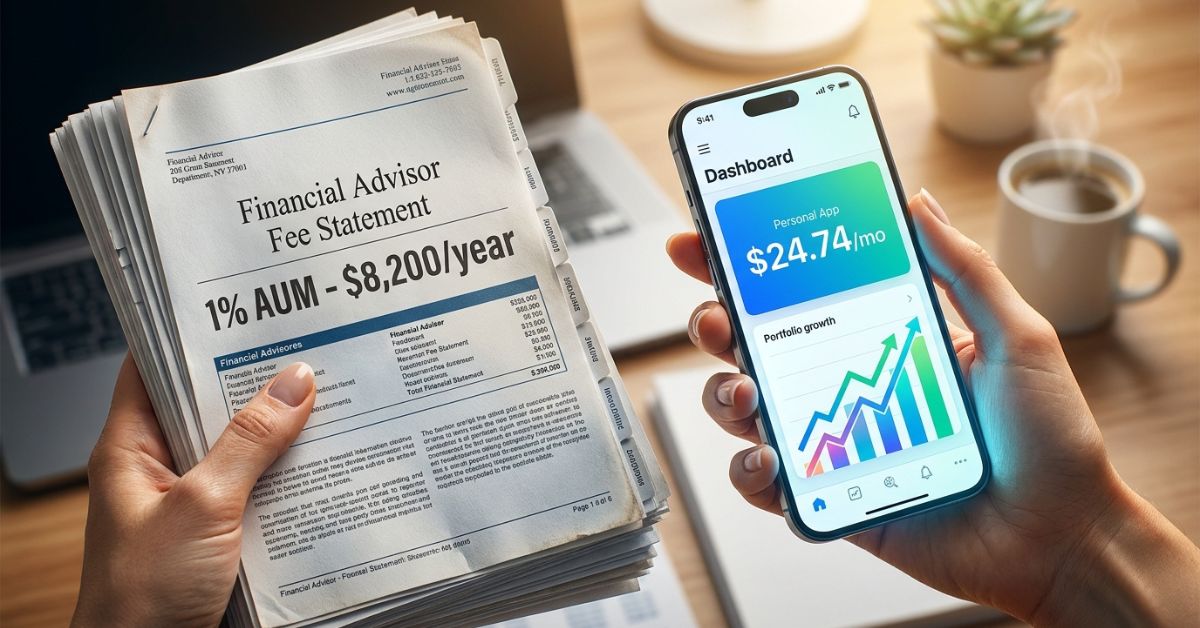
Rachel Kim, 41, a marketing director in Denver, had been paying a financial advisor $8,200 per year to manage her $820,000 portfolio.
“I met with him twice a year,” she said. “He’d show me charts and tell me everything was fine. I had no idea what was actually happening with my money.”
In January 2026, Kim switched to a combination of Betterment for investments and YNAB for budgeting. Her total monthly cost: $24.74.
“The app caught something my advisor missed. I was paying $340/month for a whole life insurance policy that made no sense for my situation. The advisor sold it to me years ago.”
Kim canceled the policy. She also found that her portfolio was 70% in actively managed mutual funds with expense ratios averaging 1.2%. The app automatically moved her to low-cost index funds.
Total first-year savings from fees and insurance: approximately $12,400.
“I feel stupid for waiting so long,” Kim said. “But mostly I feel angry that a professional took my money and did less than a $15 app does.”
WHAT’S NEXT
The next frontier is AI financial planning that goes beyond simple asset allocation.
Several apps are testing features that analyze your spending, income trajectory, career path, and life goals to create dynamic financial plans that update in real time.
“We’re moving toward a model where your financial plan is a living document, not a PDF you look at once a year,” said Lindstrom.
Regulators are paying attention. The SEC has issued guidance on AI-powered financial advice, clarifying that robo-advisors must register as investment advisers and disclose their algorithms.
But for consumers, the trend is clear.
“The financial advisor industry will need to adapt or die,” said Torres. “The value proposition of ‘trust me, I’m a professional’ doesn’t work when an app does it better for 1/50th of the cost.”
CONCLUSION
Five thousand four hundred eighty-three percent.
That number represents something bigger than app downloads. It represents a fundamental shift in how Americans manage money.
The old model — find a trusted advisor, pay them 1% forever, hope they know what they’re doing — is dying.
The new model is cheaper, faster, more transparent, and — for most people — more effective.
If you’re paying a human advisor more than $500 per year for a portfolio under $500,000, do the math. Compare the fees. Look at the performance.
The app is waiting. And it costs $15.
SOURCES:
- Deloitte, “Fintech Report Q1 2026,” deloitte.com/fintech
- McKinsey & Company, “Digital Finance Consumer Survey 2026,” mckinsey.com
- Sensor Tower, “Top Finance Apps U.S. Q1 2026,” sensortower.com
- CNBC, “Finance App Downloads Surge 5,483%,” cnbc.com
- Pew Research Center, “Trust in Financial Tools Survey 2026,” pewresearch.org
- Charles Schwab, “Modern Wealth Survey 2025,” schwab.com
- CB Insights, “Fintech Trends Report 2026,” cbinsights.com
- Betterment, “Tax-Loss Harvesting Impact Report 2025,” betterment.com
- Statista, “Robo-Advisor Market Size Projections,” statista.com