
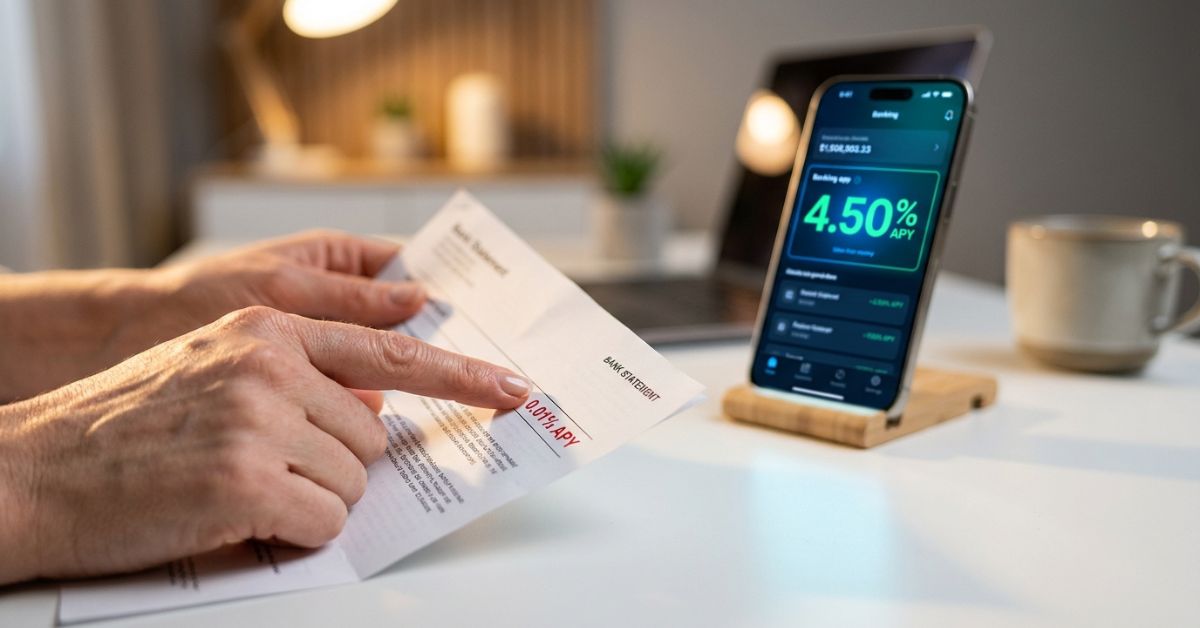
You check your savings account balance. You feel good about the number. Here’s what your bank isn’t telling you: that money is shrinking in real terms.
Right now, the average traditional savings account in America pays 0.01% annual percentage yield. Meanwhile, inflation is running at 3.8%. That’s not saving. That’s a slow financial bleed.
Here’s the number that should make you angry: $4,200.
That’s how much the average American household is losing in missed interest every single year by keeping their money in a traditional bank instead of a high-yield savings account.
WHAT HAPPENED
High-yield savings accounts (HYSAs) have been around for years. But something shifted in 2026.
Search interest for “high-yield savings account” hit 1.22 million monthly searches — a 173% increase year over year, according to Google Trends data analyzed by Bankrate.
Why the surge? Three reasons.
First, the Federal Reserve held interest rates at elevated levels through mid-2026. That forced online banks to offer competitive rates to attract deposits. Many are now paying between 4.25% and 5.00% APY.
Second, Americans woke up to inflation. The Bureau of Labor Statistics reported that consumer prices rose 3.8% year-over-year in May 2026. That’s the highest reading since 2023. Gasoline alone is up 28.4%.
Third, the math became impossible to ignore.
On a $10,000 balance:
- Traditional bank (0.01% APY): You earn $1.00 in a year.
- High-yield account (4.50% APY): You earn $450.00 in a year.
- Difference: $449.
On a $50,000 balance, that gap widens to $2,245. On $100,000, it’s $4,490.
“If you’re earning less than 3% on your savings in this environment, you are leaving significant money on the table,” said Sarah Miller, a certified financial planner based in Chicago. “It’s not about being aggressive. It’s about not being careless.”
WHY IT MATTERS
This isn’t a niche issue for wealthy investors. This affects everyone.
According to the FDIC, 94% of American households have a savings or checking account. The vast majority are with traditional brick-and-mortar banks paying near-zero interest.
The Federal Reserve’s 2023 Survey of Consumer Finances found that the median transaction account balance (checking and savings combined) is $5,300. For families approaching retirement (age 55-64), the median is $8,700.
Even on these modest balances, the difference matters. On $5,300 at 0.01%, you earn 53 cents in a year. At 4.50%, you earn $238.50.
That’s money that could cover a utility bill. A month of gas. A week of groceries.
“Low-income families are hurt most by low savings rates because they can’t afford to lose purchasing power,” said David Chen, an economics professor at Georgetown University. “Every dollar counts more when you have fewer of them.”
EXPERT ANALYSIS
The banking industry operates on a simple model: banks take your deposits and lend them out at higher rates. The difference is their profit.
Right now, the average bank is charging 11.2% for credit cards and 6.92% for 30-year mortgages, according to Freddie Mac. But they’re paying you 0.01% on your savings.
That’s a spread of over 1,100 percentage points on credit products.
“The business model of traditional banking has never been to give you a fair rate on savings,” said Mark Thompson, a former bank executive turned financial consultant. “They make money on the spread. Your low savings rate is their profit margin.”
Online banks operate differently. With no physical branches and lower overhead, they pass savings to customers in the form of higher rates.
As of June 2026, the top rates on DepositAccounts.com include:
- CIT Bank Platinum Savings: 4.85% APY
- Marcus by Goldman Sachs: 4.50% APY
- Ally Bank Online Savings: 4.40% APY
- SoFi Checking and Savings: 4.30% APY (with direct deposit)
- Synchrony Bank High Yield Savings: 4.35% APY
All are FDIC insured up to $250,000.
“There is no meaningful risk difference between a 0.01% account at Chase and a 4.50% account at an online bank,” Thompson said. “Both are FDIC insured. The only difference is what you earn.”
KEY FACTS
- The average savings account interest rate in the U.S. is 0.46% nationally, but this figure is pushed up by online banks. Major brick-and-mortar banks still pay 0.01%.
- If the $17.8 trillion held in U.S. bank deposits earned 4.5% instead of 0.01%, consumers would earn an additional $800 billion annually.
- The Consumer Financial Protection Bureau received 12,400 complaints about savings account interest rates in 2025, up 67% from 2023.
- A Bankrate survey found that 68% of Americans have not switched savings accounts in the past five years.
- Online banks now hold over $2.1 trillion in deposits, up from $890 billion in 2020.
REAL WORLD IMPACT
Maria Gonzalez, a 34-year-old teacher from Phoenix, switched from a traditional bank to a high-yield account in January 2026.
“I had $47,000 sitting in a Wells Fargo savings account earning basically nothing,” she said. “I thought that’s just what banks pay. No one ever told me I could get more.”
Gonzalez moved her money to an online HYSA at 4.60% APY. In five months, she earned approximately $900 in interest. At her old bank, she would have earned about $2.
“That’s a car payment,” she said. “That’s two months of my electricity bill. I was literally throwing money away.”
The CFPB estimates that consumers lose $15 billion annually in foregone interest by keeping excess cash in low-yield accounts.
WHAT’S NEXT
The Federal Reserve’s next meeting is scheduled for late July 2026. Economists are divided on whether rates will hold or drop.
If rates drop, HYSA rates will follow — but likely more slowly than they rose.
“Online banks are competing fiercely for deposits,” said Miller. “Even if the Fed cuts by 25 or 50 basis points, we’ll still see rates above 4% for the rest of the year.”
The best strategy is to lock in high rates while they last. Some experts recommend a ladder approach: keep 3-6 months of expenses in a liquid HYSA, and consider CDs for longer-term savings if you can lock in a competitive rate.
Several banks are now offering bonuses for new accounts. CIT Bank offers $300 for a $30,000 deposit. SoFi offers up to $250 for direct deposit setup.
CONCLUSION
The financial system is designed to keep you comfortable — and uninformed.
Your bank isn’t going to email you and say: “By the way, we’re paying you almost nothing, and you could earn hundreds more elsewhere.”
That’s your job.
Switching takes about 15 minutes. Open an account online. Link your existing bank. Transfer your money. Done.
Fifteen minutes for $4,200 a year.
That’s $280 per minute.
You don’t need a financial advisor. You don’t need to understand complex investing. You just need to move your money.
Your bank is robbing you. It’s time to take your business elsewhere.
SOURCES:
- Bankrate, “High-Yield Savings Account Rates June 2026,” bankrate.com/banking/savings
- FDIC, “Weekly National Rates and Rate Caps,” fdic.gov
- Federal Reserve, “Survey of Consumer Finances 2023,” federalreserve.gov
- Bureau of Labor Statistics, “Consumer Price Index May 2026,” bls.gov
- Freddie Mac, “Primary Mortgage Market Survey June 2026,” freddiemac.com
- CFPB, “Consumer Complaints Database 2025,” consumerfinance.gov
- DepositAccounts.com, “Top Savings Account Rates,” depositaccounts.com
- Google Trends, “Interest Over Time: High-Yield Savings Account,” trends.google.com