
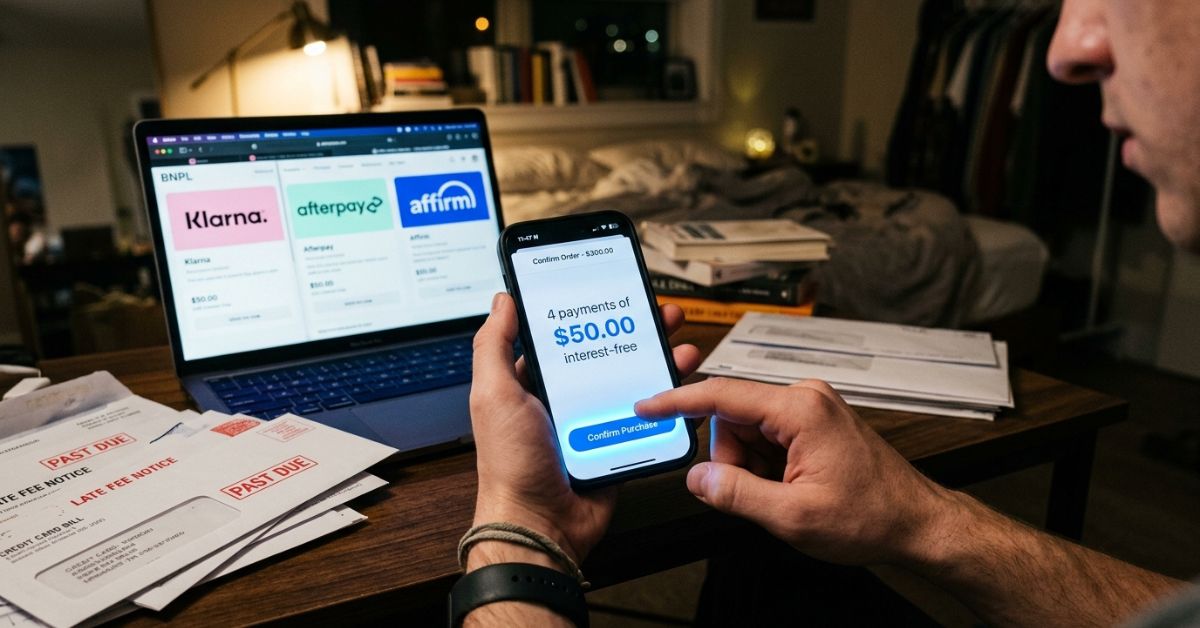
It looks harmless. Four payments. No interest. Just click confirm.
But here’s what happens after you click.
You buy a $200 jacket for four payments of $50. Easy. Then a $150 pair of shoes. Then $300 for concert tickets. Then $80 for a new phone case. Then $250 for a winter coat.
Six weeks later, you have 14 active BNPL installment plans. Four are late. The fees are piling up. Your credit score drops. And the $200 jacket is hanging unworn in your closet.
Welcome to the Buy Now Pay Later trap.
WHAT HAPPENED
In May 2026, Gallup released a bombshell poll: 50% of American adults used a Buy Now Pay Later service in the past 12 months.
That’s approximately 130 million people.
The numbers get worse. The average BNPL user has 4.3 active installment plans at any given time, according to a CFPB report released in March 2026. Nearly 28% of users report having missed at least one payment.
“BNPL has become the most common form of consumer credit in America, and it happened almost silently,” said Rohit Chopra, director of the Consumer Financial Protection Bureau, in prepared remarks accompanying the report.
The industry has exploded. Klarna, Afterpay, Affirm, and PayPal processed a combined $350 billion in transactions globally in 2025, according to company filings. That’s up from $85 billion in 2020.
Amazon, Walmart, and Target now all offer BNPL at checkout. So do most major airlines, hotel chains, and ticketing platforms.
It’s everywhere. And that’s the problem.
WHY IT MATTERS
BNPL feels different from credit card debt. There’s no interest (if you pay on time). The amounts are small. The approval takes seconds.
But the behavioral economics are dangerous.
“BNPL exploits a psychological vulnerability,” said Dr. Emily Watson, a behavioral economist at the University of Chicago. “People think in terms of ‘four payments of $25’ rather than ‘I’m spending $100.’ It decouples the pain of payment from the pleasure of purchase.”
The results are predictable.
- 34% of BNPL users say they spent more than they would have with a credit card or cash, per a 2025 Federal Reserve Bank of Boston study.
- BNPL users carry an average of $412 in outstanding BNPL balances at any time.
- Late fees average $34 per missed payment. Some services charge up to $8 per late installment.
- Unlike credit cards, BNPL late fees can kick in immediately — no 30-day grace period.
“The fees structure is punitive,” Watson said. “You can rack up $100 in late fees on a $50 purchase faster than you realize.”
EXPERT ANALYSIS
The CFPB has taken notice.
In March 2026, the agency issued guidance classifying BNPL providers as “credit card issuers” under the Truth in Lending Act. This means providers must now offer refunds for returned products, investigate billing errors, and provide standard disclosures.
“Until now, BNPL operated in a regulatory gray area,” said Marcus Webb, a consumer rights attorney based in Washington, D.C. “The CFPB’s guidance changes that. But enforcement is still catching up.”
Key features of the new regulatory framework:
- BNPL providers must now allow consumers to dispute charges.
- Refunds must be issued within 7 days for returned products.
- Late fees must be “reasonable and proportional.”
- Clear disclosure of all terms before checkout.
“You can’t just click ‘buy’ anymore without seeing the full terms,” Webb said. “Whether that changes behavior remains to be seen.”
The credit bureaus are also getting involved. TransUnion and Experian now include BNPL accounts in credit reports. Missed payments can tank your credit score.
“People think BNPL is risk-free because there’s no interest,” said Karen Cho, a credit analyst at Experian. “But a missed payment stays on your credit report for seven years. That affects car loans, mortgages, even rental applications.”
KEY FACTS
- 50% of American adults used BNPL in the past 12 months (Gallup, May 2026).
- 28% of BNPL users have missed at least one payment (CFPB, March 2026).
- Average BNPL user has 4.3 active installment plans.
- BNPL processed $350 billion in global transactions in 2025.
- Average late fee: $34 per missed payment.
- 34% of users report overspending with BNPL vs. other payment methods.
- BNPL debt is not included in standard debt-to-income ratios for mortgage applications — yet.
- 42% of BNPL users have subprime credit scores (below 670).
REAL WORLD IMPACT
James Parker, 29, a warehouse supervisor in Cleveland, started using BNPL during the 2024 holiday season. He’d never carried credit card debt.
“It felt like free money,” he said. “I bought gifts for everyone. Clothes for myself. A new TV. It was all ‘four payments of whatever.’ I didn’t keep track.”
By March 2025, Parker had 12 active BNPL plans totaling $2,100 in outstanding balances. He missed three payments in one week due to a payroll error.
“The late fees hit all at once. I owed $187 in late fees in a single month. On purchases that were supposed to be interest-free.”
Parker’s credit score dropped 98 points. His car insurance premium went up $340 per year.
“The whole thing was designed to make me fail. That’s when I realized it’s not a tool. It’s a trap.”
WHAT’S NEXT
The BNPL industry is at a crossroads.
Regulation is tightening. The CFPB has proposed additional rules that would require BNPL providers to assess borrowers’ ability to repay — a standard requirement for credit cards that currently doesn’t apply to BNPL.
“Ability-to-repay requirements would fundamentally change the BNPL model,” said Webb. “Half the people using it probably wouldn’t qualify.”
Affirm and Klarna have both publicly supported “reasonable regulation.” Afterpay has pushed back, arguing that short-term installment credit is fundamentally different from revolving credit.
Meanwhile, some states are taking action. California, New York, and Illinois have introduced bills requiring BNPL providers to be licensed as lenders and report all accounts to credit bureaus.
For consumers, the advice is simple.
“Treat BNPL like a credit card with no grace period and brutal late fees,” said Cho. “If you miss one payment, the entire benefit disappears.”
CONCLUSION
Fifty percent of Americans.
That’s not a niche product. That’s a mainstream financial tool that half the country is using.
And most of them don’t understand the risks.
BNPL is not free money. It’s an unregulated loan with severe penalties for mistakes. It’s designed to make you spend more. It’s designed to make you forget.
If you’re using BNPL, here’s the rule: no more than one active plan at a time. Set calendar reminders for every payment. Never use it for non-essential purchases.
Otherwise, you’re not buying now and paying later.
You’re paying now. And paying later. And paying again.
SOURCES:
- Gallup, “Buy Now Pay Later Usage in America 2026,” gallup.com
- Consumer Financial Protection Bureau, “BNPL Market Report March 2026,” consumerfinance.gov
- Federal Reserve Bank of Boston, “Consumer Spending and BNPL 2025,” bostonfed.org
- TransUnion, “Consumer Credit Landscape Q1 2026,” transunion.com
- Experian, “BNPL and Credit Reporting 2026,” experian.com
- Bloomberg, “Klarna Afterpay Affirm Process $350 Billion in 2025,” bloomberg.com
- Amazon, “BNPL Checkout Options,” amazon.com
- CFPB, “Truth in Lending Act BNPL Guidance March 2026,” consumerfinance.gov