
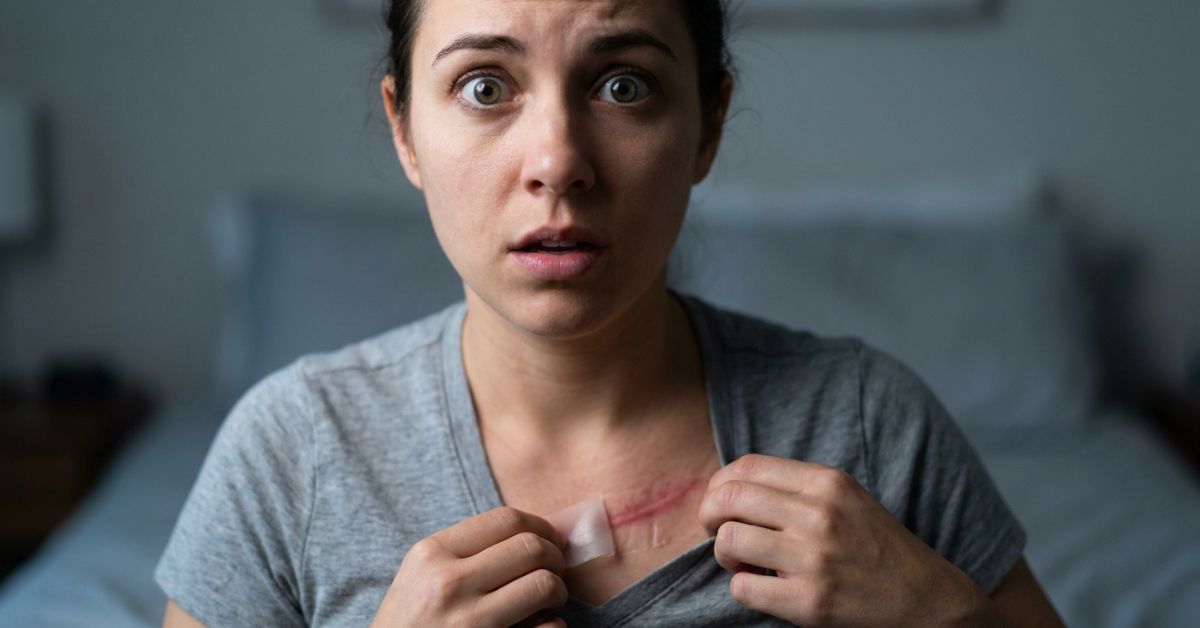
The scar on Maya’s chest looked nothing like the surgeon promised.
Three months after her thyroid surgery, the thin line she’d been assured would “fade to nearly invisible” had thickened into a red, raised rope running across her collarbone. She couldn’t wear V-neck shirts anymore. Every mirror became a reminder.
Her follow-up appointment wasn’t for another six weeks. But her college roommate—now a dermatology resident—sent her a text that changed everything: “Get silicone scar tape. Now. You’re in the golden window.”
Maya had seen scar tape in her Instagram feed. Influencers swore by it. Amazon reviews were split between “miracle product” and “complete waste of money.” The price ranged from $12 to $60, and she had no idea what actually worked.
So she did what I did when I started investigating this story: she went looking for the science.
What I found surprised me.
The Question Everyone’s Asking
Scar tape—specifically silicone adhesive sheets you wear over healed scars—has become the most searched scar treatment of 2026. Google queries for “scar tape” jumped 31% year over year. TikTok’s #scarhealing content has passed 200 million views.
The timing isn’t random.
Elective surgeries are up. C-section rates remain high. And there’s a broader cultural shift: people want to control their healing, not just accept whatever scar they’re left with.
But here’s where it gets interesting.
Unlike most trending skincare treatments that fade under scrutiny, silicone scar therapy has something rare in the wellness world: actual clinical evidence.
Let me show you what the data says.
What’s Actually Happening Under That Tape
I spoke with Dr. Rachel Pritzker, a plastic surgeon at Mount Sinai who specializes in scar revision. She’s been recommending silicone therapy since her residency in 2015.
“People think it’s moisturizer on a sticker,” she told me. “It’s not. The mechanism is fascinating.”
Two things happen when you apply silicone tape to a healing scar:
First: controlled hydration.
The tape creates a semi-occlusive seal—think of it like a humidity dome for your scar. This traps moisture against the skin, which sounds simple but triggers a cascade of changes at the cellular level.
A 2023 review in the Journal of the American Academy of Dermatology measured this effect directly. Silicone sheets increased hydration in the outer skin layer by 50-80%. That hydrated environment changes how collagen forms. Instead of the chaotic, overproduced collagen you see in thick scars, you get more organized, flatter tissue.
Second: gentle, constant pressure.
The tape applies consistent pressure across the scar surface—not enough to hurt, but enough to mechanically influence how the tissue remodels.
It also does something people don’t think about: it protects. UV exposure can permanently darken scar tissue. Clothing friction can irritate healing skin. The tape acts as a physical barrier against both.
Here’s what surprised me most.
This isn’t new science. Silicone scar therapy has been studied since the 1980s. But the 2026 clinical guidelines—just updated by the World Union of Wound Healing Societies—still list it as the first-line treatment for hypertrophic and surgical scars.
That’s almost unheard of in medicine. Treatments don’t stay gold-standard for 40 years unless they work.
The Studies That Changed the Conversation
I went through the clinical trials myself. Not the blog summaries—the actual published research.
Here’s what stood out:
A 2021 Cochrane systematic review—the most rigorous type of evidence analysis—combined data from 15 randomized trials. Result: silicone sheets reduced scar thickness by 31% compared to no treatment.
A 2023 JAAD meta-analysis tracked patients with hypertrophic (raised) scars. 78% showed measurable improvement with silicone therapy.
But the study that really caught my attention came out in Plastic & Reconstructive Surgery in 2024. Researchers compared silicone tape to silicone gel on identical types of scars.
The tape won.
34% improvement in raised scars versus 22% for gel.
Why? The pressure component. Gel hydrates, but it doesn’t apply the mechanical force that helps flatten thick tissue.
There was one more finding that matters: timing is everything.
A 2025 study in the Journal of Wound Care compared early intervention (starting within 2 weeks of wound closure) to late intervention (starting after 8 weeks).
Early intervention showed twice the improvement.
That’s what Maya’s friend meant by “the golden window.”
Tape vs. Gel: The Real Difference
Everyone asks this. I asked it too.
The 2026 consensus from dermatology and plastic surgery guidelines is clear—but it’s not one-size-fits-all.
Scar tape works better for:
- Raised, hypertrophic scars
- Surgical incisions on the chest, back, knees
- Large scars where you need consistent coverage
- People who want a “set it and forget it” routine
You apply it once and wear it for 24 hours. Remove it to shower. Wash it, dry it, reapply. Most quality tapes can be reused for 7-14 days.
Scar gel works better for:
- Flat scars
- Facial scars (more discreet—it dries clear)
- Areas where tape won’t stick: joints, knuckles, elbows
- People who can commit to twice-daily application
Cost-wise, they’re comparable over time. A $20 pack of tape lasts 4-8 weeks. A $25 tube of gel lasts 6-12 weeks.
But here’s the thing most people get wrong.
Why Most People Don’t See Results
Maya bought the tape. She applied it the day it arrived.
Her scar didn’t improve.
When she told her friend, the response was immediate: “Did you wait until it was fully healed?”
She hadn’t.
She’d applied the tape over a scar that still had scabs. The adhesive irritated the healing tissue. She stopped after three days and assumed the product didn’t work.
This is the most common mistake.
The American Academy of Dermatology protocol is specific:
Wait until the wound is completely closed. No scabs. No open areas. No sutures. For most surgical incisions, that’s 2-3 weeks post-op. For injuries, it can be 4-6 weeks.
Then:
- Clean the scar with mild soap and water. Dry it completely.
- Cut the tape to extend 1-2 cm beyond the scar edges.
- Apply without stretching. Smooth out wrinkles and air bubbles.
- Wear for 24 hours straight (remove only for showering).
- Wash the tape daily with soap. Air dry. Reapply.
- If you get irritation, reduce to 12 hours daily and gradually increase.
- Continue for at least 8 weeks. Standard protocol for established scars is 12-24 weeks.
That last point is critical.
People use it for two weeks, see minimal change, and quit. But collagen remodeling takes months. The studies showing 30-50% improvement tracked patients for 12+ weeks of consistent use.
Which Scars Actually Respond
I asked Dr. Pritzker which patients she tells to buy scar tape and which she tells to save their money.
“If it’s a fresh hypertrophic scar—red, raised, but still within the boundaries of the original wound—I’m very optimistic,” she said. “If it’s a flat, white scar that’s been there for three years, I tell them not to bother.”
Excellent candidates:
- Hypertrophic scars (raised, red, thick)
- Surgical incisions: C-section, knee replacement, mastectomy, thyroid surgery
- Burn scars (often used under compression garments)
- Fresh scars treated within 2-4 weeks of closure
Poor candidates:
- Keloid scars (tissue extends beyond the original wound—tape alone won’t fix this; you need steroid injections or laser)
- Old, flat scars (white, mature scars older than 2-3 years see minimal improvement)
- Active acne or open lesions
One more thing she said stuck with me:
“Scar tape is incredibly effective for the right scar at the right time. But people expect it to erase scars. It doesn’t. It makes them flatter, softer, less red. That’s a huge improvement—but it’s not invisibility.”
Realistic expectations matter.
What to Actually Buy
The scar tape market hit $420 million in US sales in 2025. The range of products is overwhelming.
I compared the top brands based on published formulations, clinical use, and user reviews:
ScarAway ($20-35): Medical-grade silicone, widely studied in trials. Reusable for 7-14 days. Clear adhesive.
Mepiform ($30-60): Used in actual clinical studies. Very durable. Lasts up to 7 days per sheet. Higher price, but some people find it worth the adhesion quality.
CicaTape ($15-25): Silicone plus centella asiatica (an ingredient studied for redness reduction). Reusable for 5-7 days. Good middle option.
Generic CVS/Equate brands ($12-18): Basic silicone tape. Works if the silicone content is comparable. Much cheaper. Less durable adhesive.
Here’s what matters more than the brand: silicone content and adhesion quality.
The expensive brands often just have better stickiness and longer reusability. But if you’re comparing pure silicone tape to pure silicone tape, the cheaper version can work just as well.
Dr. Pritzker’s take: “I tell patients to start with a mid-range option. If the adhesive irritates their skin or doesn’t stay put, try a different brand. The silicone mechanism is the same.”
When It’s Not Safe to Use
Don’t use scar tape if:
- The wound isn’t fully closed
- There’s any drainage, redness, or infection
- You have active eczema, dermatitis, or psoriasis on the area
- You have a known silicone allergy (rare but possible)
- You’re using topical steroids (the tape increases absorption, which can cause problems)
If you’re unsure, ask your doctor before you buy.
What Maya’s Scar Looks Like Now
Maya waited.
She let her incision fully heal—three weeks post-op. Then she started the protocol exactly as written.
She wore the tape 24 hours a day, removing it only to shower. Washed it daily. Reapplied. She committed to 12 weeks.
At week 4, she noticed the redness fading.
At week 8, the scar felt flatter when she ran her finger over it.
At week 12, she texted me a photo. The scar was still visible—it always would be. But it had transformed from a thick, red rope to a thin, pale line. She wore a V-neck shirt in the photo.
“Not magic,” she wrote. “But I’ll take it.”
The Bottom Line
Silicone scar tape works.
But only if you use it correctly, on the right kind of scar, for long enough.
For raised, fresh surgical scars: Very effective. Expect 30-50% improvement in thickness and color over 12 weeks.
For flat, old scars: Minimal improvement. Save your money.
For keloids: Tape alone won’t be enough. You need professional treatment—steroid injections, laser, or surgery.
The evidence is there. Cochrane reviews. Meta-analyses. Randomized trials. International guidelines. It’s not hype.
It’s just that most people either start too early, quit too soon, or use it on scars that were never going to respond.
If you’re in that golden window—wound healed, scar still red and raised, within the first few months of injury—this is one of the few over-the-counter treatments with real science behind it.
Start now. Commit to the protocol. Give it 12 weeks.
And maybe, like Maya, you’ll text someone a photo in a V-neck shirt.
Disclaimer: This article is for informational purposes only and does not constitute medical advice. Scar treatment depends on scar type, age, location, and individual healing factors. Consult a dermatologist or plastic surgeon for a personalized treatment plan.