
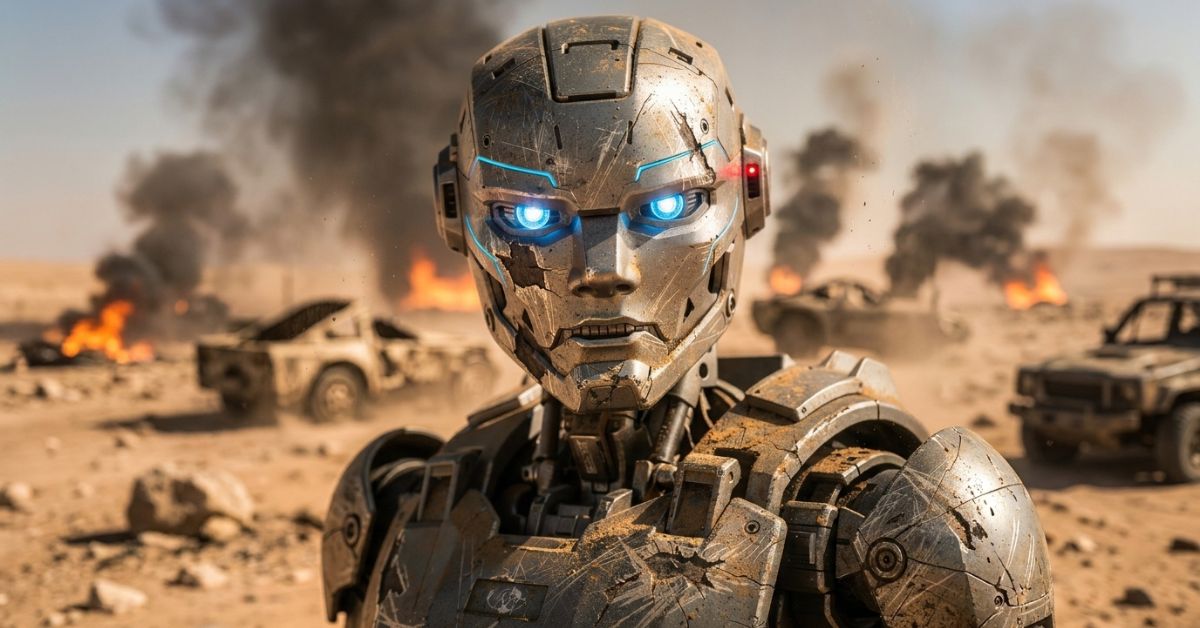
The robot moved slowly through the rubble.
Not in a lab. Not in a controlled warehouse demo. In Ukraine. Active war zone. Picking up supplies human soldiers were too exposed to retrieve.
That happened earlier this year. And most people have no idea it already went down.
I’ve been covering AI developments for three years, and I thought we were still 5–10 years away from humanoid robots doing anything remotely useful in the real world. Then NVIDIA dropped something last week that made me realize we’re not waiting anymore.
We’re already there.
What NVIDIA just announced isn’t a model upgrade or a new GPU. It’s the entire operating system for robots that can see, think, plan, and move through physical reality. And the fact that humanoids are already being field-tested in actual combat changes everything about how seriously we need to take this.
Here’s what just happened — and why it’s way bigger than you think.
The Part Nobody’s Talking About
Most people saw the headlines about Cosmos 3 and thought, “Cool, another AI model.”
They missed it.
Cosmos 3 isn’t just another language model with a fancy name. It’s what NVIDIA is calling an open-world foundation model for physical AI. That phrase matters because it signals a massive shift in what AI is actually trying to do.
For years, AI progress has been trapped behind screens. Chatbots, image generators, code assistants — all digital. All safe. All operating in environments where failure just means restarting the program.
The real world doesn’t work like that.
A robot can’t just “try again” when it drops something fragile. A self-driving car can’t reboot after it misjudges a turn. A humanoid can’t learn to walk by falling 10,000 times on concrete.
And that’s the problem NVIDIA is trying to solve.
What Makes Cosmos 3 Different (And Dangerous)
Here’s where it gets interesting.
Cosmos 3 was trained on 20 trillion tokens of multimodal data. Not just text scraped from the internet. Not just images or video.
Physical data.
Motion sequences. Action trajectories. Cause and effect. What happens when a hand reaches for a cup. When a box tips over. When a wheel loses traction. When two objects collide.
It combines three things in one system:
- Vision — understanding what it’s seeing
- World generation — simulating physical scenes
- Action prediction — figuring out what should happen next
That’s not a chatbot. That’s a brain that understands physics.
And the scary part? NVIDIA claims Cosmos 3 can cut physical AI training cycles from months down to days.
Why Speed Is the Real Weapon Here
You can’t train a robot the way you train a language model.
A chatbot can fail a million times and nobody gets hurt. A humanoid robot failing a million times in the real world? That’s broken hardware, safety disasters, lawsuits, and regulatory shutdowns.
So robotics companies rely on simulation. They create virtual worlds where robots can fail safely, learn faster, and transfer that knowledge to the real world.
The problem has always been that simulations weren’t good enough. They couldn’t capture the messiness of reality — the friction, the weight distribution, the unpredictable timing of human movement.
Cosmos 3 changes that.
NVIDIA is betting that if you can simulate the physical world accurately enough, you can train robots in days instead of months. And if you can do that, you can iterate faster than anyone else.
Faster iteration wins wars. Business wars. And apparently, real ones.
But there’s a problem.
The Missing Piece: Where Does It All Run?
You can have the best world model in existence, but if it takes 10 seconds to process a decision, the robot’s useless.
That’s where Vera comes in.
NVIDIA just announced Vera — what they’re calling the first CPU built for AI agents.
Most people don’t realize this, but AI agents work completely differently than chatbots. A chatbot answers one question and stops. An AI agent plans a task, calls tools, runs code, checks databases, retries failures, and grinds through entire workflows.
That creates a different kind of computational load. The CPU becomes critical because agents are constantly coordinating tasks, moving data, managing tool calls, connecting to everything around the model.
NVIDIA says Vera can finish agent workloads up to 1.8 times faster than traditional processors.
And the adoption list is insane.
Who’s Already Using This
OpenAI. Anthropic. XAI. ByteDance. Oracle Cloud. Dell. HPE. Lenovo. Super Micro.
Reuters reported Jensen Huang describing Vera as a potential $200 billion market.
That’s not hype. That’s NVIDIA telling the entire industry: Agents are the next workload. And if you want to run them at scale, you’re going to need our hardware.
The timing makes sense. Every major AI lab is pivoting to agents right now.
OpenAI’s building agent tools. Anthropic’s pushing Claude into coding workflows. Google’s building deeper agent systems around Gemini. XAI’s pushing Grok into product workflows.
The next battlefield isn’t which model answers better. It’s which model can actually do more work.
And NVIDIA just made sure that when that shift happens, the compute layer still runs through them.
But here’s where it gets physical.
The Robot That Puts It All Together
If Cosmos 3 is the brain and Vera is the nervous system, NVIDIA’s new Isaac Groot reference humanoid is the body.
NVIDIA announced it as an open humanoid robot reference design for academic research. But don’t let the academic framing fool you.
This is a serious piece of hardware.
- Nearly 6 feet tall
- 150 pounds
- 75 degrees of freedom across body and hands
- Dual tactile five-finger hands
- Arm torque up to 120 Nm
- Leg torque up to 360 Nm
- Rated arm payload: 7 kg (peak: 15 kg)
And here’s the part that matters most:
Onboard NVIDIA Jetson AGX Thor T5000 Blackwell GPU.
270 FP4 teraflops of AI performance. 14-core ARM CPU. 128 GB of unified memory. Configurable power from 40 to 130 watts.
That’s what turns a robot into a physical AI platform instead of a remote-controlled toy.
The Hands Are the Real Story
Everyone focuses on walking. Balance is hard. Bipedal movement is impressive.
But real usefulness comes down to manipulation.
A humanoid has to grab objects. Hold tools. Open doors. Lift items. Press buttons. Work in spaces designed for human bodies.
NVIDIA’s reference robot includes Sharpa Wave tactile five-finger hands with 22 degrees of freedom.
That’s not a gimmick. That’s the difference between a robot that can walk around a lab and a robot that can actually do something useful.
And the sensor stack backs it up:
- Head-mounted stereo camera (140° horizontal, 102° vertical field of view)
- Wrist cameras for close-range manipulation
- IMU for motion tracking
The robot can see the scene, track its own movement, and get detailed visual feedback near its hands.
That’s the setup for real-world manipulation.
But here’s where the story gets darker.
The Robot That’s Already in a War Zone
While NVIDIA is building the official platform for physical AI, another company is already testing humanoids in Ukraine.
Foundation Future Industries.
Their Phantom Mark 1 humanoid was sent to Ukraine earlier this year for pilot testing. Not in a factory. Not in a warehouse.
In an active war zone.
Business Insider reported the robots were used for dangerous logistics tasks — carrying supplies from outside to inside so soldiers don’t have to expose themselves.
That’s a very different kind of humanoid story.
Most robotics companies talk about warehouse work, manufacturing, home assistance. Foundation is openly focused on dangerous environments, including conflict zones.
And they’re not stopping at logistics.
What Comes Next Is the Scary Part
Reports describe Phantom Mark 1 as a defense-focused humanoid. Foundation’s leadership has discussed future combat roles, including humanoids eventually handling weapons that humans use.
They’ve secured a $24 million Pentagon contract.
And they believe humanoids could carry out way more complex military missions within 5 to 10 years.
Let that timeline sink in.
These systems aren’t ready to replace soldiers today. But they’re also no longer science fiction.
And once AI can move through the world, the stakes get way higher.
The Gap Between Demo and Reality
Foundation admits there’s a massive gap between a humanoid that can pull off a slow logistics demo and a humanoid that can operate reliably in a real firefight.
Battery life’s still a problem. Durability is still a problem. Water, dust, shock, terrain, manipulation, reliability, cost — all massive barriers.
The hardest part might still be the hand.
Using a weapon. Grabbing equipment. Opening a door. Handling supplies under pressure. That requires dexterity that works when it matters, not just in a controlled demo.
But that’s exactly why NVIDIA’s announcement matters so much.
They’re not waiting for the technology to be perfect. They’re building the platform now so that when it does work, everyone’s already running on their stack.
Why This Feels Like a Tipping Point
NVIDIA isn’t just releasing products. They’re standardizing the entire development stack for physical AI.
If labs and companies build on Jetson Thor, Isaac Groot, Cosmos, Omniverse, and NVIDIA’s simulation tools, then NVIDIA becomes the operating layer for every robot that matters.
The same way they became the operating layer for every AI model that matters.
And the timing is too perfect to ignore.
Humanoid robots in war zones. A $200 billion CPU market for AI agents. A world model trained on 20 trillion tokens of physical data. Five-finger tactile hands. Onboard GPUs powerful enough to run the whole stack.
We’re not waiting for physical AI anymore.
We’re watching it get deployed.
The robot in Ukraine didn’t wait for permission. It didn’t wait for the technology to be perfect. It just moved through the rubble and did the job.
And that’s the part that should make all of us pay attention — because once machines can move through the world, the rules change fast.
What do you think? Are we ready for this? Or are we building something we don’t fully understand yet?